
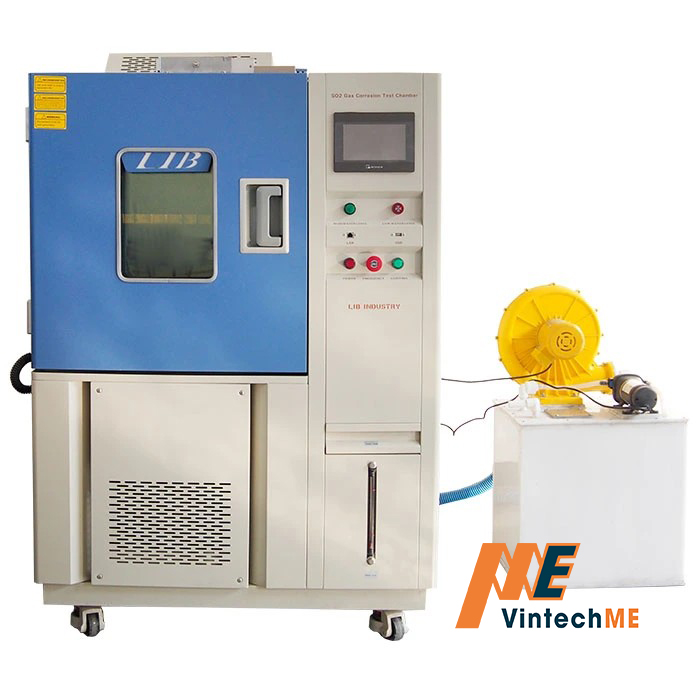
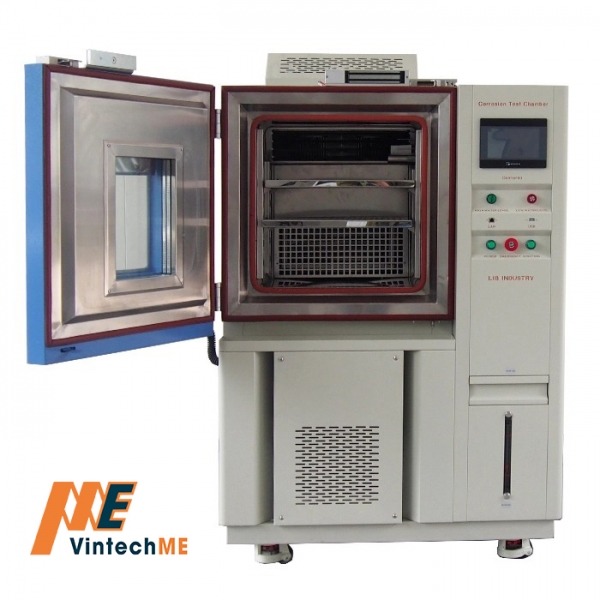
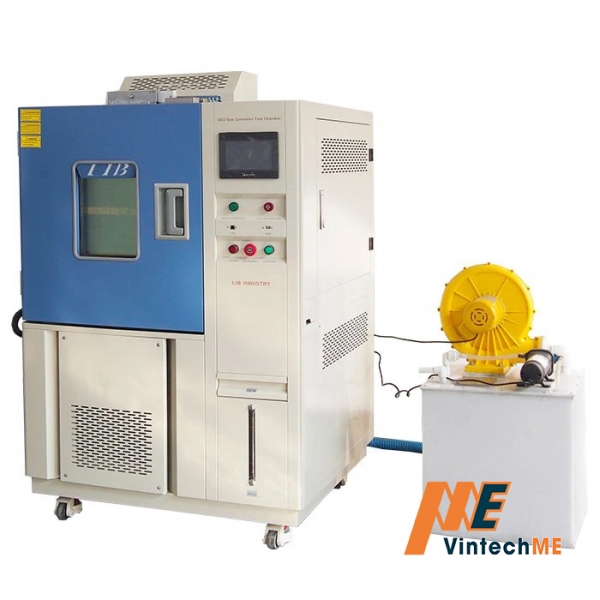
The LIB SO₂ Corrosion Test Chamber is designed to simulate a corrosive sulfur dioxide atmosphere for evaluating the durability of materials, protective coatings, and components exposed to industrial pollution or acidic environments.
Table of Contents
The chamber introduces SO₂ gas into the test space while simultaneously controlling gas concentration, temperature, humidity, and test duration. LIB’s standard product range supports an SO₂ concentration of 1 to 30 ppm, a temperature range of 15 to 80°C, and a humidity range of 30 to 98% RH.
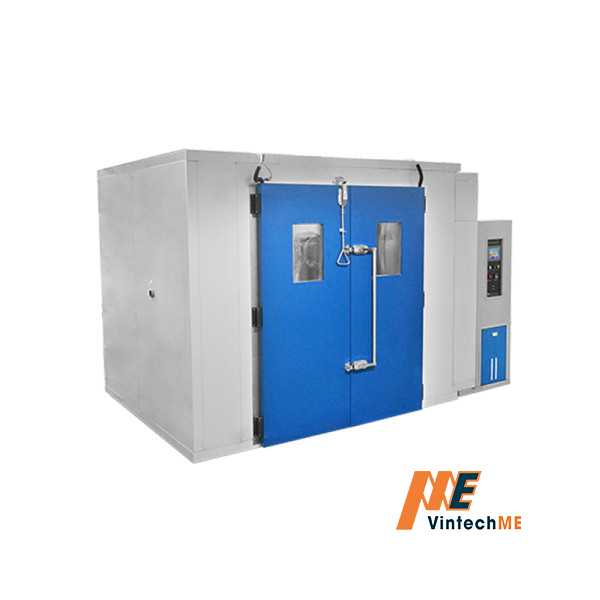
LIB offers various chamber capacities from 100 to 1,000 liters. Reach-in, walk-in, and customized configurations are also available to accommodate different specimen sizes and testing requirements.
What Is SO₂ Corrosion Testing?
SO₂, or sulfur dioxide, is a gas commonly found in industrial emissions and polluted environments. When combined with high humidity, SO₂ can create a mildly acidic atmosphere that accelerates oxidation and corrosion on metal surfaces.
SO₂ corrosion testing is used to reproduce these conditions in a controlled laboratory environment. This enables manufacturers to evaluate:
-
The corrosion resistance of metals.
-
The durability of paint, plating, and protective coatings.
-
The performance of electrical connectors, terminals, and electrical components.
-
Changes in appearance and functionality after testing.
-
The effectiveness of surface treatment solutions.
-
The suitability of materials before mass production.
This test method is particularly suitable for products used in industrial areas, polluted urban environments, locations exposed to chemical emissions, or hot and humid climates.
Operating Principle of the SO₂ Corrosion Test Chamber
During testing, SO₂ gas is introduced into a sealed test chamber at a preset concentration. The control system maintains the programmed temperature, humidity, and test cycle.
An air circulation system distributes the SO₂ gas uniformly throughout the chamber, ensuring that all specimens are exposed to a stable and consistent atmosphere. Temperature and humidity can be set independently to reproduce a wide range of environmental conditions.
At the end of the test cycle, the remaining gas is directed to an exhaust treatment system. LIB chambers use a NaOH solution tank and spray mechanism to help neutralize SO₂ before discharge, improving safety in the laboratory area.
Key Features of the LIB SO₂ Corrosion Test Chamber
SUS316 Stainless Steel Test Chamber
The test chamber is manufactured from SUS316 stainless steel, which provides excellent corrosion resistance under conditions involving temperature, humidity, and SO₂ gas.
This construction helps improve the durability and service life of the equipment during long-term operation.
Gas-Tight Door Structure
Two layers of corrosion-resistant silicone rubber seals are installed between the chamber door and the cabinet body.
This design minimizes the risk of SO₂ leakage into the working environment.
Precise Temperature and Humidity Control
Temperature and humidity inside the test chamber can be adjusted independently.
This allows users to establish test conditions suitable for specific products, materials, and technical standards.
SO₂ Gas Concentration Control
An SO₂ gas sensor continuously monitors the concentration inside the chamber.
The system automatically adjusts the gas supply to maintain a stable test environment and improve the repeatability of test results.
Uniform Gas Circulation System
A circulation fan helps mix and distribute SO₂ gas evenly throughout the chamber.
This reduces concentration differences between different specimen locations.
Touchscreen Controller
The chamber is equipped with a color LCD touchscreen controller that supports:
-
Test cycle programming.
-
Data recording.
-
Result storage.
-
Fault alarms.
-
Ethernet connection to a computer.
Exhaust Gas Treatment System
Residual SO₂ gas is passed through a dedicated neutralization system after testing.
This design helps prevent the release of corrosive gas and improves operational safety.
Technical Specifications of the LIB SO₂ Corrosion Test Chamber
| Specification | SO-100 | SO-225 | SO-500 | SO-800 | SO-1000 |
|---|---|---|---|---|---|
| Test chamber volume | 100 L | 225 L | 500 L | 800 L | 1,000 L |
| Internal dimensions | 400 × 500 × 500 mm | 500 × 600 × 750 mm | 700 × 800 × 900 mm | 800 × 1,000 × 1,000 mm | 1,000 × 1,000 × 1,000 mm |
| Overall dimensions | 860 × 1,050 × 1,620 mm | 960 × 1,150 × 1,860 mm | 1,180 × 1,350 × 2,010 mm | 1,280 × 1,550 × 2,110 mm | 1,500 × 1,550 × 2,110 mm |
| Temperature range | 15–80°C | 15–80°C | 15–80°C | 15–80°C | 15–80°C |
| Temperature fluctuation | ±0.5°C | ±0.5°C | ±0.5°C | ±0.5°C | ±0.5°C |
| Humidity range | 30–98% RH | 30–98% RH | 30–98% RH | 30–98% RH | 30–98% RH |
| SO₂ concentration | 1–30 ppm | 1–30 ppm | 1–30 ppm | 1–30 ppm | 1–30 ppm |
| Air exchange rate | 3–5 times/hour | 3–5 times/hour | 3–5 times/hour | 3–5 times/hour | 3–5 times/hour |
| Chamber material | SUS316 | SUS316 | SUS316 | SUS316 | SUS316 |
| Controller | Programmable color LCD touchscreen | ||||
| Connectivity | Ethernet and computer connection | ||||
| Gas sensor | SO₂ gas sensor | ||||
| Water supply | Automatic filtered water supply system | ||||
| Door lock | Electromagnetic door lock | ||||
| Exhaust treatment | SO₂ gas treatment and neutralization system |
The chamber dimensions and capacities above are based on LIB’s standard SO-series models. Certain measurement configurations, accuracy levels, and auxiliary systems may vary depending on the selected version or customized requirements.
Applicable Test Standards
LIB gas corrosion test chambers can be configured to support test methods involving SO₂ and corrosive gas environments, including:
-
ISO 6988.
-
ISO 3231.
-
DIN 50018.
-
ASTM G87.
-
IEC 60068-2-42.
-
IEC 60068-2-60.
-
EIA-364-65.
The chamber configuration should be selected based on the required gas concentration, temperature, humidity, test cycle, and safety requirements specified in the applicable standard.
The list of compatible standards may differ between single-gas SO₂ chambers and mixed-gas corrosion chambers.
Applications of the SO₂ Corrosion Test Chamber
Automotive and Electric Vehicle Industry
The chamber can be used to evaluate the corrosion resistance of:
-
Electrical connectors and terminals.
-
Decorative plated parts.
-
Logos, nameplates, and exterior trim.
-
Automotive lamps and lighting assemblies.
-
Metallic components in the engine compartment.
-
Electronic control units and equipment housings.
-
Battery assemblies and high-voltage components.
-
Paint and corrosion-protection coating systems.
Electrical and Electronics Industry
The SO₂ chamber is suitable for testing:
-
Printed circuit boards.
-
Electrical connectors.
-
Switches and relays.
-
Control cabinets.
-
Telecommunications equipment.
-
Sensors.
-
Electrical distribution equipment.
Metals and Coatings
The system supports the evaluation of:
-
Industrial paint coatings.
-
Zinc-plated surfaces.
-
Nickel- or chrome-plated surfaces.
-
Anodized surfaces.
-
Conversion coatings.
-
Steel, aluminum, and alloy materials.
-
Corrosion-protection systems.
Aerospace, Railway, and Heavy Industry
Components used in polluted environments, areas with industrial emissions, or high-humidity conditions can be tested to determine long-term durability and the risk of functional degradation.
Electronics, automotive components, metals, and coatings are among the main application areas for LIB SO₂ corrosion test chambers.
How Is SO₂ Corrosion Testing Different from Salt Spray Testing?
Salt spray tests such as NSS mainly create a chloride-ion environment to evaluate resistance to salt-induced corrosion.
In contrast, an SO₂ chamber simulates the effects of sulfur dioxide gas combined with temperature and humidity.
Because the corrosion mechanisms are different, the two methods cannot fully replace one another.
| Evaluation criterion | SO₂ corrosion test | Salt spray test |
|---|---|---|
| Main corrosive agent | SO₂ gas and humidity | NaCl salt solution |
| Simulated environment | Industrial emissions and acid rain | Marine environments and salted roads |
| Typical test specimens | Metals, plated parts, and electrical connectors | Metals, paints, and protective coatings |
| Corrosion mechanism | Acidic gas and moisture corrosion | Chloride-ion corrosion |
| Main purpose | Evaluate durability in polluted atmospheres | Evaluate resistance to salt corrosion |
Companies should therefore select the appropriate test method based on the actual service environment, product standard, and expected failure mechanism.
Benefits of Using an SO₂ Corrosion Test Chamber
Investing in an SO₂ corrosion testing system provides several benefits:
-
Early identification of material corrosion risks.
-
Comparison of different coating systems.
-
Evaluation of electrical component performance.
-
Reduced durability assessment time.
-
Support for material and surface-treatment selection.
-
Product quality verification before mass production.
-
Improved component reliability in industrial environments.
-
Support for field corrosion failure analysis.
-
Improved supplier quality control.
Safety Considerations During Operation
SO₂ is a toxic, irritating, and corrosive gas. The chamber must therefore be installed in an area with appropriate ventilation, gas leakage detection, exhaust piping, and a properly designed neutralization system.
Only trained personnel should operate the equipment. All operations must comply with the manufacturer’s instructions, chemical safety procedures, and laboratory regulations.
The chamber must not be operated if the door locking system, gas sensor, alarm system, or exhaust treatment system is not functioning correctly.
Why Choose Testing Equipment from VintechME?
VintechME provides environmental and corrosion testing solutions for laboratories, R&D centers, and manufacturing facilities in the automotive, electronics, metal, coating, and materials industries.
Customers receive comprehensive support, including:
-
Consultation on chamber capacity and SO₂ concentration range.
-
Assessment of applicable testing standards.
-
Configuration design based on specimen size.
-
Consultation on gas supply and exhaust treatment systems.
-
Equipment installation and commissioning.
-
Operator training and user guidance.
-
Maintenance, calibration, and technical support.
-
Customized solutions for specific laboratory requirements.
Contact VintechME
For customers looking for an SO₂ Corrosion Test Chamber, sulfur dioxide corrosion chamber, toxic gas test chamber, or corrosion durability testing system for metals, coatings, and electronic components, please contact VintechME for configuration consultation.
VINTECHME VIETNAM
Hotline: +84 966 252 565
Email: info@vintechme.com
Website: www.vintechme.com
Có thể sử dụng trực tiếp bản này cho website tiếng Anh của VintechME.

 Tiếng Việt
 English

