
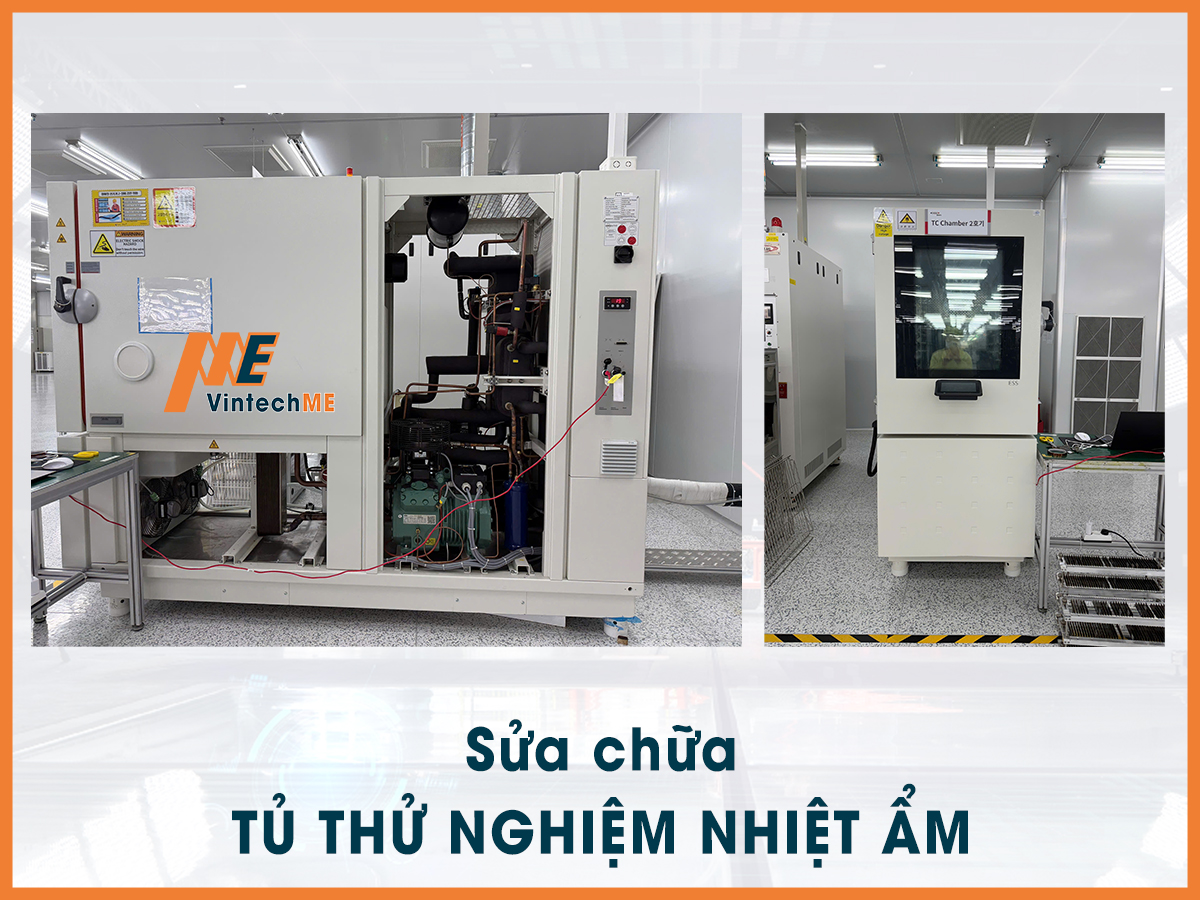
Last June, the VintechME engineering team directly supported a customer in inspecting and repairing a Weiss Technik C7-270/15 temperature and humidity test chamber that was experiencing an unusually slow cooling rate. Following an on-site inspection, the root cause was identified as an insufficient amount of refrigerant in the refrigeration system. The article below presents the detailed process of analysis, diagnosis, and corrective action for this issue.
Table of Contents
The Weiss Technik temperature and humidity test chamber is one of the most widely used environmental testing systems in the automotive, electronics, semiconductor, aerospace, defense, and medical device industries. With its highly accurate temperature and humidity control capabilities, the equipment helps companies evaluate product durability, reliability, and service life in accordance with international standards.
However, after many years of operation or without regular maintenance, a Weiss Technik test chamber may develop refrigeration system problems. One of the most common issues is an insufficient amount of refrigerant. This fault reduces cooling capacity, prevents the equipment from achieving the specified temperature change rate, and directly affects test results.
Recently, the VintechME engineering team directly supported a customer in inspecting and repairing a Weiss Technik C7-270/15 temperature and humidity test chamber that was experiencing an unusually slow cooling rate. Following an on-site inspection, the root cause was identified as an insufficient amount of refrigerant in the refrigeration system. The article below presents the detailed process of analysis, diagnosis, and corrective action for this issue.
The customer was operating a Weiss Technik C7-270/15 temperature and humidity test chamber with the following technical specifications:
Designed cooling rate: 15°C/min
Test program:
Hold at 85°C
Then cool down to -45°C
In theory:
The total temperature difference is 130°C
At a cooling rate of 15°C/min, the chamber should reach -45°C in approximately 8.7 minutes
However, during actual operation:
After 10 minutes, the chamber temperature had only decreased to approximately 20°C
The equipment failed to achieve the cooling rate specified by the manufacturer
The actual temperature curve remained significantly higher than the programmed setpoint
This issue extended the total test duration and affected temperature cycling tests, environmental durability tests, and product reliability evaluations.
After receiving the service request, the VintechME engineering team carried out a systematic inspection of the equipment in order to accurately determine the cause of the problem.
The engineers first reviewed the complete alarm history of the equipment.
The inspection results showed:
No controller faults
No high-pressure or low-pressure alarms
No temperature sensor faults
The test program was running normally
These findings indicated that the control system was not the cause of the slow cooling performance.
The engineers then ran a heating test program.
The results showed:
The heating rate met the design specification
The temperature increased steadily
No temperature fluctuation or overheating was observed
This allowed the engineers to rule out possible faults involving:
Heater elements
Heating SSR
PID controller
Operating program
The results confirmed that the heating system was operating normally.
Because the fault occurred only during cooling, the complete refrigeration system was inspected in detail.
The inspection included:
Compressor suction pressure
Discharge pressure
Suction line temperature
Discharge line temperature
Compressor operating current
Cooling fan operation
Condenser operation
Evaporator operation
After measurement and inspection, the engineers identified the following conditions:
Suction pressure was lower than the standard operating value
Cooling performance had noticeably decreased
The compressor continued to operate, but the cooling capacity was very poor
The cooling time was significantly longer than the design requirement
These are typical signs of an insufficient refrigerant charge.
After reviewing all on-site inspection and measurement results, VintechME determined the root cause of the problem as follows:
The refrigeration system of the Weiss Technik test chamber contained an insufficient amount of refrigerant, resulting in reduced cooling capacity and preventing the chamber from achieving the designed cooling rate.
Although the compressor was still operating, the amount of refrigerant circulating through the system was not sufficient to absorb and transfer heat from the test space to the outside environment.
This is a common issue in Weiss Technik environmental test chambers that have been operating for an extended period or have developed refrigerant leaks at pipe connections, welded joints, or service valves.
The refrigeration system of a Weiss Technik test chamber operates based on a vapor-compression refrigeration cycle.
In this cycle, the refrigerant absorbs heat at the evaporator and releases heat at the condenser.
When the refrigerant charge is insufficient:
Refrigerant circulation flow decreases
The heat absorption capacity of the evaporator is reduced
Heat transfer efficiency decreases
Cooling capacity drops significantly
The compressor must operate continuously for a longer period
The chamber temperature decreases very slowly
Continued operation under these conditions may lead to:
Longer test cycles
Failure to achieve the required temperature change rate
Increased energy consumption
Reduced compressor service life
Potential damage to refrigeration system components
After accurately identifying the cause, the VintechME engineering team carried out the repair process in accordance with proper technical procedures.
The complete refrigeration system was inspected to identify the source of refrigerant loss.
The following areas were checked:
Refrigerant pipe connections
Service valves
Welded joints
Condenser
Evaporator
If a leakage point is detected, it must be completely repaired before new refrigerant is charged into the system.
After confirming that the refrigeration system was fully sealed, the engineers vacuumed the system in order to:
Remove air
Remove moisture
Ensure a clean internal refrigeration circuit
Improve cooling performance after refrigerant charging
VintechME used the correct refrigerant type recommended by Weiss Technik and charged the system with the quantity specified by the manufacturer.
Using the correct refrigerant type and charging the correct amount are essential for achieving optimum cooling performance and protecting the compressor’s service life.
After completing the refrigerant charging process, the engineers continued to inspect:
Suction and discharge pressures
Compressor operating current
Cooling rate
Temperature stability
The complete test chamber operating program
The results showed that:
The equipment regained the cooling rate specified by the manufacturer
The actual temperature closely followed the programmed setpoint
The test cycle operated stably
The refrigeration system returned to normal operation
The Weiss Technik test chamber was restored to stable operating condition and once again met the customer’s testing requirements.
To keep a Weiss Technik temperature and humidity test chamber operating reliably, VintechME recommends performing preventive maintenance every 6 to 12 months.
The following items should be checked:
Refrigeration system pressure
Refrigerant charge level
Refrigerant leakage
Condenser and evaporator cleanliness
Compressor performance
Cooling fan operation
Temperature and humidity sensor calibration
Test chamber temperature change rate
Regular maintenance helps detect early signs of performance degradation, prevent major failures, and extend the service life of the equipment.
VintechME specializes in the repair, maintenance, and calibration of Weiss Technik temperature and humidity test chambers, thermal shock chambers, walk-in chambers, and many other environmental testing systems.
Our services include:
On-site inspection and fault diagnosis
Refrigeration system repair
Refrigerant leak detection and repair
System vacuuming and refrigerant charging
Replacement of compressors, electronic expansion valves, and refrigeration components
Temperature and humidity calibration
Preventive maintenance and equipment performance optimization
Nationwide technical support
With an experienced engineering team and a professional inspection process, VintechME is committed to delivering fast, effective, and cost-efficient solutions. Our services help businesses reduce equipment downtime and ensure that testing processes continue to meet the required level of accuracy.
.jpg)
.jpg)
.jpg)
.jpg)
Contact VintechME if your Weiss Technik temperature and humidity test chamber experiences any of the following problems:
Cooling performance is slower than the design specification
The chamber cannot achieve the required temperature change rate
The compressor operates continuously but cooling performance remains poor
The actual temperature consistently lags behind the programmed setpoint
Test cycles take significantly longer than normal
The VintechME engineering team is ready to provide prompt inspection, diagnosis, and repair support.
VINTECHME VIETNAM JSC
Hotline: 0966 252 565
Email: info@vintechme.com
Website: https://vintechme.com
 Tiếng Việt
 English

